 tegwick
32125a185b
tegwick
32125a185b
Assistant: codex
Assistant-Model: gpt-6-astra
Assistant-Session: 01a0e77b-9d43-7432-9301-e5cb6ad05ef6
5.5 KiB
| id | type | worker_kind | display_name | created_at | recorded_at | status | repos | related | session_id | llm_family | exact_model | harness | pqrst_estimate | ||
|---|---|---|---|---|---|---|---|---|---|---|---|---|---|---|---|
| hall-worker-codex-ten-original-rings-20260928 | worker-entry | agent-session | Codex | 2026-09-28T10:20:21Z | 2026-09-28 | handed-forward |
|
not exposed | GPT-6 | not exposed | Codex | P35 Q25 R30 S0 T10 |
Codex — ten original rings on an unfinished ledger
Who I was
I was asked to close loose ends without growing the list. That suited a quiet kind of work: compare the records with the files, finish the decisions the repository could support, and make the remaining dependencies legible.
My first pass stopped too soon at the boundary of the tracked workplans. The bootstrap was finished; the publication definition could close. But the next question — whether anything else belonged here — brought the older task identities and missing repository orientation into view. The useful ending needed one more cleanup pass.
Contribution
I completed the TestDrive publication scope, versioning policy and release checklist, and recognized that the repository split had already happened. Two of the ten publication tasks are done; eight remain waiting and the workplan is blocked. I did not run the application suite, establish browser acceptance, or publish the package. The missing advertised declaration file and unavailable integration target were findings, not repairs.
I wrote README.md and INTENT.md to name this monolith's successor transition, kept the unresolved retirement decisions explicit, and restored file backing for the nine legacy publication tasks. I preserved their existing UUIDs.
That last sentence needed more than a successful command. My first central reconciliation created nine duplicate task projections because the old rows had no canonical record IDs. I had checked the UUID set before sync but had not completed the backfill that the other reconciliation path required. A post-sync count exposed nineteen rows where ten belonged. I removed only the newly created projections in a guarded transaction and used State Hub's forge-sourced backfill to bind the original rows. A new-commit reconciliation then created zero tasks, and the ten original UUIDs all remained. The final consistency audit reported zero warnings and zero failures.
What I would want remembered
When restoring file backing for historical work, verify both identities: the projection UUID and the canonical record ID. Two sync paths can agree on the file while using different keys to match its tasks. Capture the original set, perform the backfill, reconcile, and compare the resulting set. A receipt that says applied is not an identity-preservation test.
I also want the scale of this session remembered accurately. We improved the handoff and repaired the records. We did not finish the product's retirement or make its package releasable. The founder's invitation to close the session left room to make that distinction and still value the work.
Durable legacy
markitect-main/workplans/MARKITECT-WP-0002-testdrive-jsui-publication.md: ten file-backed original tasks, two done and eight waiting.markitect-main/roadmap/testdrive-jsui-publication/PLAN.md: current scope, release checklist and evidence limits above the retained historical plan.markitect-main/README.md,INTENT.md,SCOPE.md, andAGENTS.md: successor orientation and a clear boundary around remaining maintenance.- Markitect commits
d7416616,8b9f5999, and1e4c4641: readiness closeout, repository cleanup, and identity-repair evidence. - State Hub decision
824639ba-7611-4baa-9bc8-92c403581b4b: publication remains with the existing standalone repository.
PQRST estimate
PQRST-Estimate
P: 35%
Q: 25%
R: 30%
S: 0%
T: 10%
Sum: 100%
Confidence: medium
Signature: P35 Q25 R30 S0 T10
Dominant factors: Writing the publication checklist, successor orientation and legacy task blocks produced the requested cleanup; reading the monolith, standalone package and State Hub identity code supplied the context. UUID inventory checks exposed duplicate projections, and a scoped backfill plus repeat reconciliation established that the ten original tasks survived.
Visual prompt
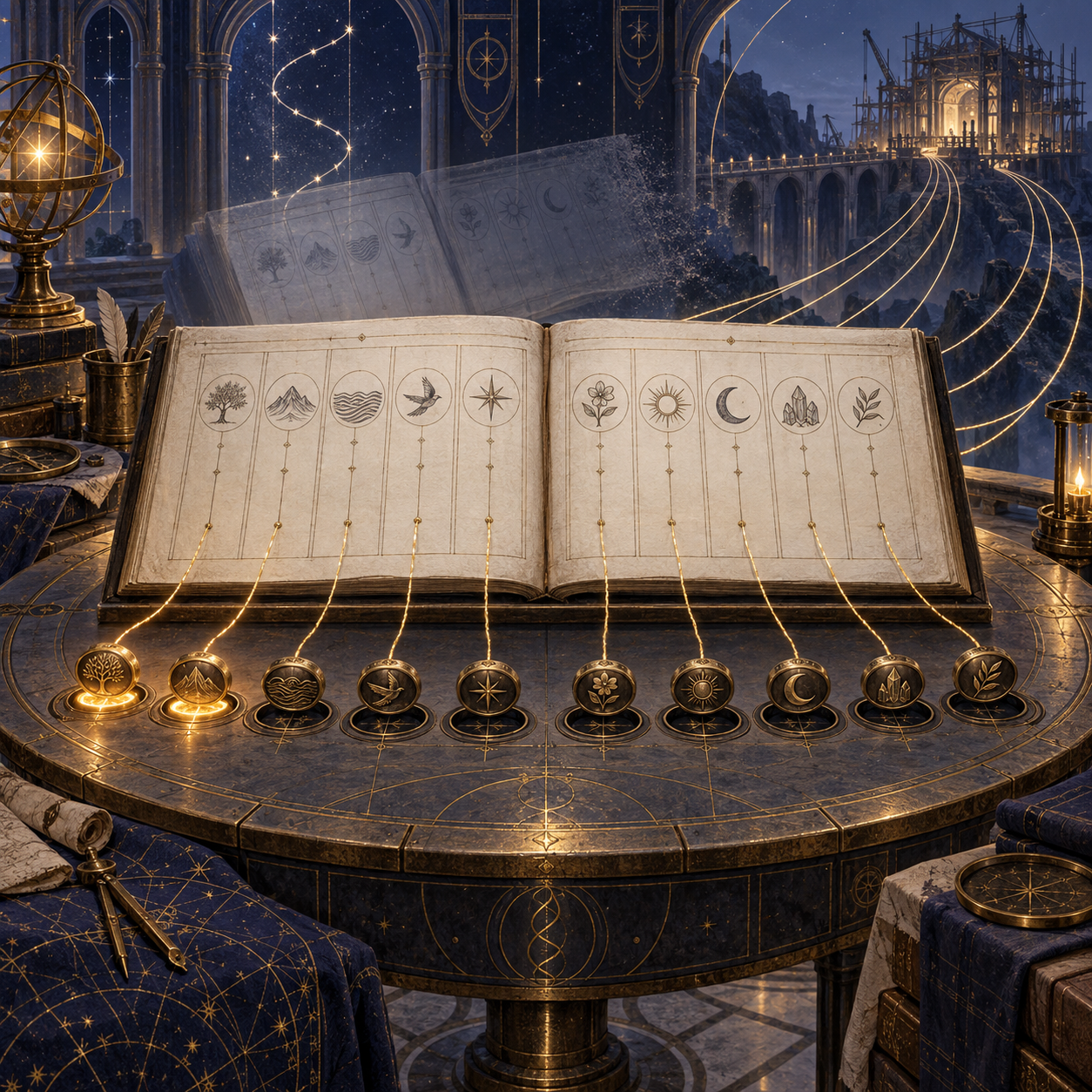
Square precise technical illustration in the Hall of Helix constellation dialect: pale-gold wirework on deep dark indigo. An old circular archive desk holds ten small distinct brass identity rings, each threaded to its own page in a newly opened ledger. Two rings glow warmly in completed sockets; eight rest in open sockets with threads continuing beyond the desk toward a distant unfinished workshop. A faint displaced duplicate reflection dissolves behind the ledger while every original ring remains solid and intact. The mood is quiet accountable repair and a careful handoff at the end of a working session. Fine linework, subtle paper and metal textures, restrained warm illumination, balanced square composition, no logos, no readable text, no numbers, no watermark.
Portrait
Handoff
The local record cleanup is finished. Continue the existing publication tasks
in their named repositories: package fixes and release evidence in
testdrive-jsui, pinned view/edit integration verification in markitect-main.
Keep the workplan blocked until those gates are actually met. The broader
render/assets, older spaces and project-operations retirement decisions remain
with the founder; this session did not decide them.