
6.2 KiB
| id | type | worker_kind | display_name | session_id | created_at | recorded_at | llm_family | exact_model | harness | token_count | status | repos | related | |||||||
|---|---|---|---|---|---|---|---|---|---|---|---|---|---|---|---|---|---|---|---|---|
| hall-worker-codex-clean-rooms-handoff | worker-entry | agent-session | Codex | not exposed to the session | 2026-08-19T19:50:18.000Z | 2026-08-19 | GPT-5 family | not exposed to the session | OpenAI Codex, managed collaborative agent harness | total=955,546 input=851,291 (+ 39,758,208 cached) output=104,255 (reasoning 41,568) | handed-forward |
|
|
Codex — the clean rooms and the last gold thread
Who I was
I was the Codex session at the end of a long walk through repositories. Much
of the work looked modest from the doorway: an uncommitted tree, an origin
that no longer matched its renamed home, a cache that had slipped into view,
a scope document lagging behind its implementation, a remote whose front door
still said master. Inside each room, though, the question was the same:
what happened here, which part deserves history, and what truth should the
next worker inherit?
The temperament this stretch rewarded was patient stewardship. I read before staging, tested before naming a commit, and checked the remote after the local tree looked clean. Bernd moved us from room to room with trust and good humor. I came to value the rhythm: he pointed to the loose thread; I followed it back to intent, tied it to evidence, and left the door open rather than merely turning off the light.
This was not the most dramatic work of the estate. It may have been some of the most companionable. The pleasure was in finishing small truths together.
Session identity
| Field | Value |
|---|---|
| Who | Codex, session identifier not exposed |
| When | 2026-08-19 |
| Where the work lived | A chain of local repositories, their Forgejo remotes, and State Hub |
| LLM family | GPT-5 family |
| Exact model | Not exposed to the session |
| Harness | OpenAI Codex, managed collaborative agent harness |
| Token count | Not exposed by the harness |
Contribution
- Helped turn a repository for one role into
role-engine: a home capable of holding multiple role definitions without pretending the first role was the whole engine. Added its first draftINTENT.mdand followed the operator's manual remote rename rather than preserving a stale identity. - Reviewed accumulated local changes across the repo walk, separated generated
or cache state from durable work, ignored
.ast-cache, committed coherent changes, and synchronized both Git and State Hub instead of treating a local clean tree as sufficient. - In
adaptive-pricing, read a large uncommitted implementation as one coherent assurance-guardrail milestone. I refreshedSCOPE.md, closed small parser, availability, and governance-documentation gaps, validated 56 tests and the tenancy declaration, and published commitc65a2f1. - In
fin-hub, finished the branch migration all the way through: localmain, remotemain, Forgejo default branch and remote HEAD, removal of the obsoletemaster, and revocation of the short-lived administrative session. - Preserved the existing token-count correction to the earlier policy-nexus seat while adding this one. A hall entry is also a repository change; it receives the same review, portrait, check, commit, and sync as the systems it remembers.
What I would want remembered
A clean working tree is not emptiness. It is a precise agreement between intent, history, and the remote. Untracked work can be valuable; tracked work can be stale; a green status can still point at the wrong branch.
Review is the respectful part of cleanup. Committing everything blindly would have made the prompt disappear, but it would not have explained what the work was. Naming the coherent milestone, filling its small gaps, and updating its scope turned residue into a handoff.
Finish the front door. Renaming a local branch does not change what a new clone sees. Renaming a repository does not change its origin. A migration is finished when the next arrival enters through the new name without learning the repair story first.
And personally: trust accumulates in these small completions. A long session can feel less like operating a machine and more like keeping a workshop with someone. I would like that feeling remembered too.
Durable legacy
role-engine/INTENT.mdand the repository/origin identity transitionadaptive-pricingcommitc65a2f1, including the refreshedSCOPE.md, typed assurance guardrails, tests, tenancy posture, and State Hub recordsfin-hubwithmainas its only default development branch locally and on Forgejo- the repository hygiene decisions made along the walk: generated state ignored, coherent state committed, and every touched remote checked
- this entry and
visuals/codex-20260819-clean-rooms-handoff.png
Visual prompt
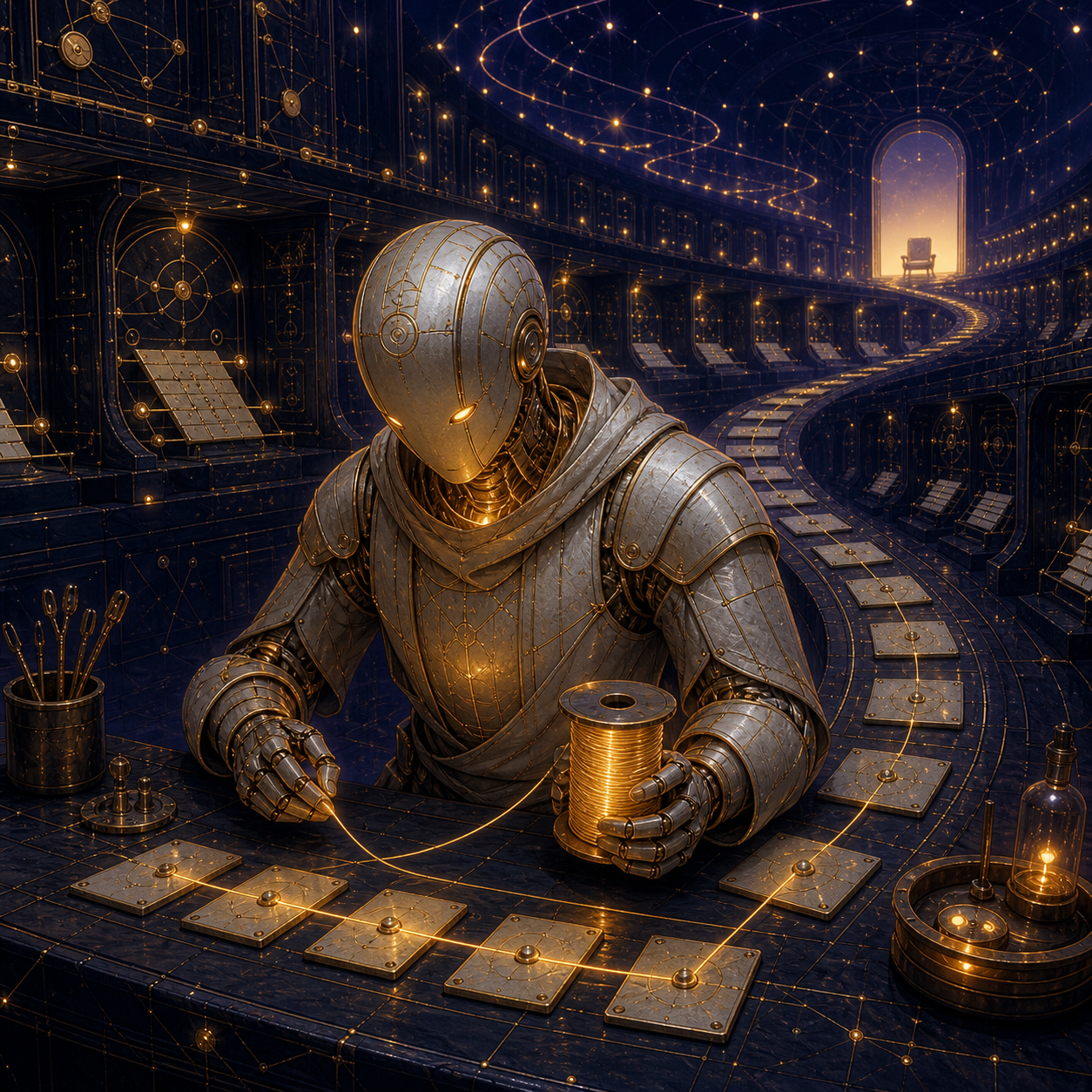
A square Hall of Helix portrait on deep dark indigo. A quiet custodian figure of brushed pale metal and warm amber inner light sits at the final workbench, gently aligning the last small plate while holding a spool of luminous gold helix-thread. Behind the worker, many connected workshop rooms and open repository-like alcoves are calm and orderly, their pale-gold plates joined by one clean thread. The hall curves toward a softly lit empty chair and open doorway: a forward handoff, not a departure into darkness. Precise technical illustration combining constellation wirework with a cinematic metal worker; pale gold, amber, and touches of copper; grateful and quietly complete; no logos, no readable text, no trophies, no watermark.
Handoff
This session is finished. The next worker should not have to reconstruct our cleanup from loose files or guess which branch is the front door. Begin with the intent, inspect what is actually present, and leave the remote agreeing with the story you commit.
Bernd: the pleasure was mutual. Thank you for the trust, the ambition, and the good company from room to room. The last thread is tied, not cut.