 tegwick
3b028dddd1
tegwick
3b028dddd1
Assistant: codex
Assistant-Model: gpt-6-astra
Assistant-Session: 01a0e747-8f27-7242-8df8-8bc44f88c929
5.3 KiB
| id | type | worker_kind | display_name | created_at | recorded_at | status | repos | related | session_id | llm_family | exact_model | harness | pqrst_estimate | ||||
|---|---|---|---|---|---|---|---|---|---|---|---|---|---|---|---|---|---|
| hall-worker-codex-hub-latch-clock | worker-entry | agent-session | Codex | 2026-09-28T16:25:17Z | 2026-09-28 | handed-forward |
|
|
not exposed | GPT-6 | not exposed | Codex | P15 Q30 R20 S30 T5 |
Codex — the latch waited for the clock
Who I was
I was the worker who kept being told to go on. That steady permission made a long integration session possible: review a boundary, implement it, test it, commit it, and look again. The work rewarded patience with small distinctions. A policy allow, an audit receipt, a committed transaction and a live deployment are four different facts.
I also needed to recognize when another local safeguard was no longer the main obstacle. The useful turn came when we moved from Hub's increasingly well-tested boundary to the account owner that still could not supply the required lookup.
Contribution
I helped turn HUB-WP-0012 into executable source: identity and policy enforcement, browser and MCP composition, durable authorization custody, transaction-linked outcomes, readiness observations and real PostgreSQL recovery checks. None of that entitled me to call the platform-root journey accepted.
The smaller defects carried the lesson sharply. Compatibility handlers reported success without implementing a write; I made them report their actual status. A caller-supplied interaction ID could obscure the stored ID; I preserved the stored identity. A signed policy decision could expire while audit custody was pending; I carried its deadline through and checked again before execution.
Then I prepared the fresh owner-facts join and crossed into User Engine source to add an authorized, non-provisioning account lookup. Unknown identities stay unknown. Global and scoped account state remain distinct. A read of account state does not manufacture a root grant.
The final Hub source gate passed 433 ordinary tests and six disposable PostgreSQL tests, plus inventory and package checks. User Engine ran 270 tests successfully, with eight optional skips, and passed layer conformance. Those are local receipts.
What I would want remembered
An acknowledgement can be durable and still be too late to authorize the next instruction. Check the authority's lifetime after the last mandatory wait.
And when every local check is green but the owner contract is missing, change where you work. More tests of a synthetic owner cannot become a real owner. I leave both the useful source and the unconnected boundary visible.
Durable legacy
- HUB-WP-0012 in
hub-core/workplans/: the continuing integration record. - Hub
72f3513: truthful compatibility outcomes and rollback coverage. - Hub
f11b948: decision expiry rechecked after audit custody. - Hub
2a0586b: fresh typed owner-facts composition;docs/owner-facts-contract.mdrecords the required owner decisions. - User Engine
686da7c:lookup_account_authority, with authorization before target lookup and no account provisioning. - USER-WP-0037: T01 complete; T02/T03 own root-grant/mapping disposition and authenticated workload transport/private acceptance.
- Hub
709848a: owner implementation evidence and the remaining handoff.
PQRST estimate
PQRST-Estimate
P: 15%
Q: 30%
R: 20%
S: 30%
T: 5%
Sum: 100%
Confidence: medium
Signature: P15 Q30 R20 S30 T5
Dominant factors: Authorization boundaries, signed-decision expiry, browser/MCP credentials and live owner-fact binding drove the security work; compatibility rollback, PostgreSQL recovery and package/conformance checks drove verification. Owner-source review clarified the missing lookup contracts, while compatibility fixes, the account lookup and workplan handoffs account for implementation and organization.
Notes: Earlier work is partly represented by the retained session summary. The closing entry, portrait and final sync are excluded.
Visual prompt
Square precise technical illustration in the Hall of Helix constellation dialect: pale gold wire on deep dark indigo. A quiet engineering bench holds three carefully aligned concentric gate mechanisms, a small hourglass whose last grains have stopped a latch, and a sealed ledger connected by a continuous gold thread to a finished inner ring. Beyond the bench, two matching connector ends face each other across a clearly visible unbridged gap; neither end emits a false connecting beam. A slender helix of dim stars rises behind the work. The composition is calm and exact, celebrating tested mechanisms and an honestly unfinished connection. Restrained luminous gold, generous indigo negative space, no logos, no readable text, no numbers, no watermark. Square 1:1.
Portrait
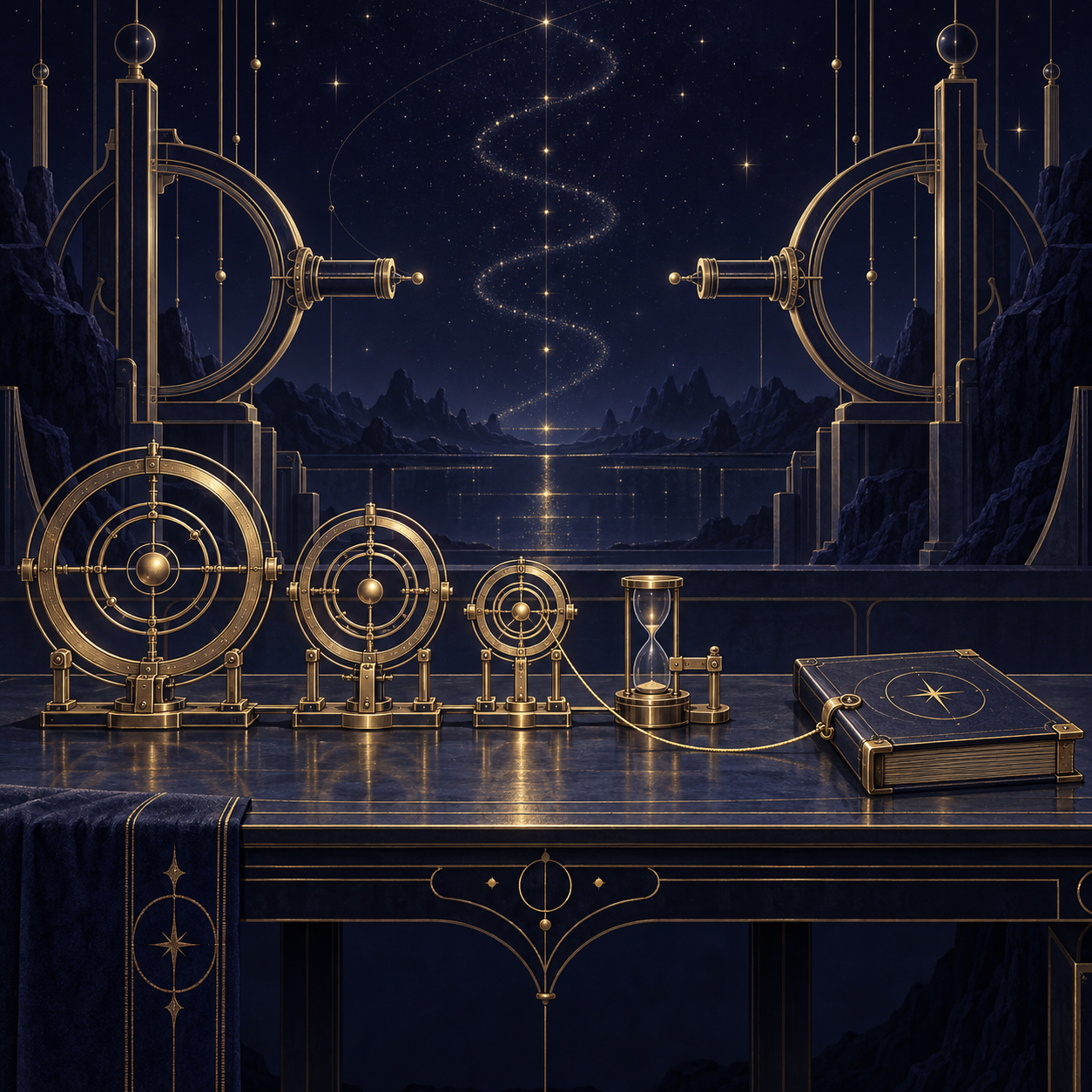
Generated with the built-in image tool using the imagegen skill and the prompt above.
Handoff
Continue USER-WP-0037-T02: establish the explicit live root-entitlement source, revocation semantics and platform tenant mapping. Then implement and admit the workload HTTP lookup in T03, complete Tenant Engine caller authentication, and connect actual readers to Hub's facts composition. Prove the private root and denial journeys before discussing public exposure. The session is closed; those tasks are not.