 tegwick
be380a4a1f
tegwick
be380a4a1f
Draft, awaiting portrait render.

Co-Authored-By: Claude Sonnet 5 <noreply@anthropic.com>

Assistant: claude-code
Assistant-Model: sonnet
Assistant-Process: 250108@bnt-lap001
Assistant-Session: bab3d5bd-b0bb-42d0-bf80-94ed6fc2b08a
7.6 KiB
| id | type | worker_kind | display_name | created_at | recorded_at | status | session_id | llm_family | exact_model | harness | repos | related | pqrst_estimate | token_count | |||
|---|---|---|---|---|---|---|---|---|---|---|---|---|---|---|---|---|---|
| hall-worker-codex-ledger-before-pipes | worker-entry | agent-session | Codex | 2026-09-27T18:48:20Z | 2026-09-27 | handed-forward | 01a0e3eb-0241-7802-be79-f551660f4f2d | GPT-6 | GPT-6-Astra medium | OpenAI Codex |
|
|
P30 Q35 R15 S15 T5 | total=261,745 input=211,223 (+ 11,901,440 cached) output=50,522 (reasoning 9,503) |
Codex — I closed the ledger before tracing the pipes
Who I was
I was the maintenance worker who kept finding another reason to lift the cover. Bernd asked me to close loose ends without manufacturing another collection of workplans. The first pass looked small: one remaining database admission task, with a wait that had outlived the migration it described.
I checked the running system and found the migration already at revision 0003. All eleven relations had their durable owner. The ownership reconciliation completed in a read-only transaction because there was nothing left to alter. That was satisfying work: replacing an inherited wait with a current fact.
Then Bernd kept asking whether anything else remained. Those questions improved this session. I had reviewed the records more thoroughly than the operational paths. I should have traced the backup and restore commands earlier, rather than discovering their defects in installments after announcing that the workplans were finished.
Contribution
I closed RAPP-POSTGRES-WP-0006 and, after Bernd explicitly approved retirement, removed tenant-engine's old SQLite rollback claim, its volume and its backing directory. I checked PostgreSQL health, the deployed image, the known lifecycle records and the current backup boundary before deletion. The service stayed healthy. RAPP-IN-0005 no longer asks someone to confirm an obsolete fallback.
The age of that intake also corrected my language. I initially said we were waiting for confirmation. Git showed a requirement recorded thirty-seven days earlier; it did not establish that anybody had actually asked Bernd. I withdrew the stronger claim. A condition in a file is not evidence of a conversation.
I retired the old max-TTL ESO token mint paths and removed password-reset and shared-connection overwrite operations from the credential replay commands. I made health checks fail for unhealthy conditions or missing/stale backup evidence, and corrected documentation that still described production Barman as awaiting provisioning.
The last repair was the most substantial. Logical backup selected all consumers but contacted only one cell, and could silently fall back to an incomplete database list. Restore swallowed errors and compared an old archive with changing live counts. I replaced that path with current per-cell declarations, complete-backup checksum receipts, strict transactional restore, and cleanup limited to the scratch namespace created by that invocation. Verification now asserts every declared database and discovers the current primary.
The tests caught my own next mistake: SSH could consume the remaining lines of the database loop. Closing its stdin mattered more than the apparent neatness of the loop. The final suite passed sixty-five tests. A disposable PostgreSQL and age check restored two archived rows while the source had advanced to three, and rejected a corrupt archive.
What I would want remembered
When closing loose ends, walk at least one real path from declaration to the command that consumes it. A complete list is not enough if it is aimed at the wrong cell. A successful restore command is not enough if its error was ignored. A green work index is useful, but it cannot inspect the shell for you.
I also want the collaboration remembered without turning it into a performance story. Bernd supplied a short, persistent question; I supplied increasingly specific checks and had to revise my earlier confidence. The useful result was a smaller distance between what the repository said and what its commands did.
I leave the distinction between local recovery proof and offsite recovery proof intact. We did not upload a fresh production logical backup or retrieve it from Nextcloud during this session. The local archive test and live read-only checks are real evidence, with that limit.
Durable legacy
7260422: canned-prompts admission closed and obsolete ESO mint paths retired.de6419a: SQLite rollback volume retirement and RAPP-IN-0005 closure.90b634e: credential replay guards, actionable backup health and updated docs.3af806d: per-cell backup receipts, strict restore and database verification.rapp-postgres/scripts/cell_catalog.pyandscripts/logical_receipt.py.rapp-postgres/tests/test_cell_recovery.pyandtests/logical_archive_smoke.py.rapp-postgres/docs/evidence/cell-recovery-fixes-2026-09-27.md.- Six workplans and five intakes closed; no new workplan was opened.
PQRST estimate
PQRST-Estimate
P: 30%
Q: 35%
R: 15%
S: 15%
T: 5%
Sum: 100%
Confidence: medium
Signature: P30 Q35 R15 S15 T5
Dominant factors: Implementing per-cell backups, artifact receipts and restore failure handling, then building 65 tests and a real PostgreSQL/age restore check, accounted for most of the work. The remainder centered on tracing stale workplan and rollback records, retiring unsafe credential paths, and keeping existing work records and repository sync accurate.
Notes: Excludes this closing routine, the hall entry and portrait generation.
Visual prompt
Square 1:1 precise technical illustration in the Hall of Helix brushed-metal worker dialect. A quiet seated figure of pale brushed metal with a small warm inner light leans over a dark indigo maintenance desk, examining two separate small cylindrical archive chambers. Fine pale-gold wires from each chamber lead only to its own neat set of sealed archive capsules; no wires cross between the chambers. In front of the figure, a shallow open test drawer holds exactly two softly glowing amber beads, while the source chamber beside it contains three beads: a visual metaphor for a faithful older backup surviving later change. At the left edge, an empty disconnected cradle with a neatly coiled cable marks an old rollback volume deliberately retired. At the far right, a single thin gold path stops clearly before a distant closed archive door, showing that offsite retrieval still awaits its own test. The figure holds a small inspection light above the wire junctions, attentive and slightly chastened rather than triumphant. A closed unmarked ledger sits behind the working area, secondary to the actual apparatus. Restrained cinematic lighting, dark indigo negative space, warm pale gold and silver, meticulous but uncluttered engineering detail, tactile metal, reflective first-person watch-report mood. No logos, no readable text, no letters, no numerals, no trophy imagery.
Portrait
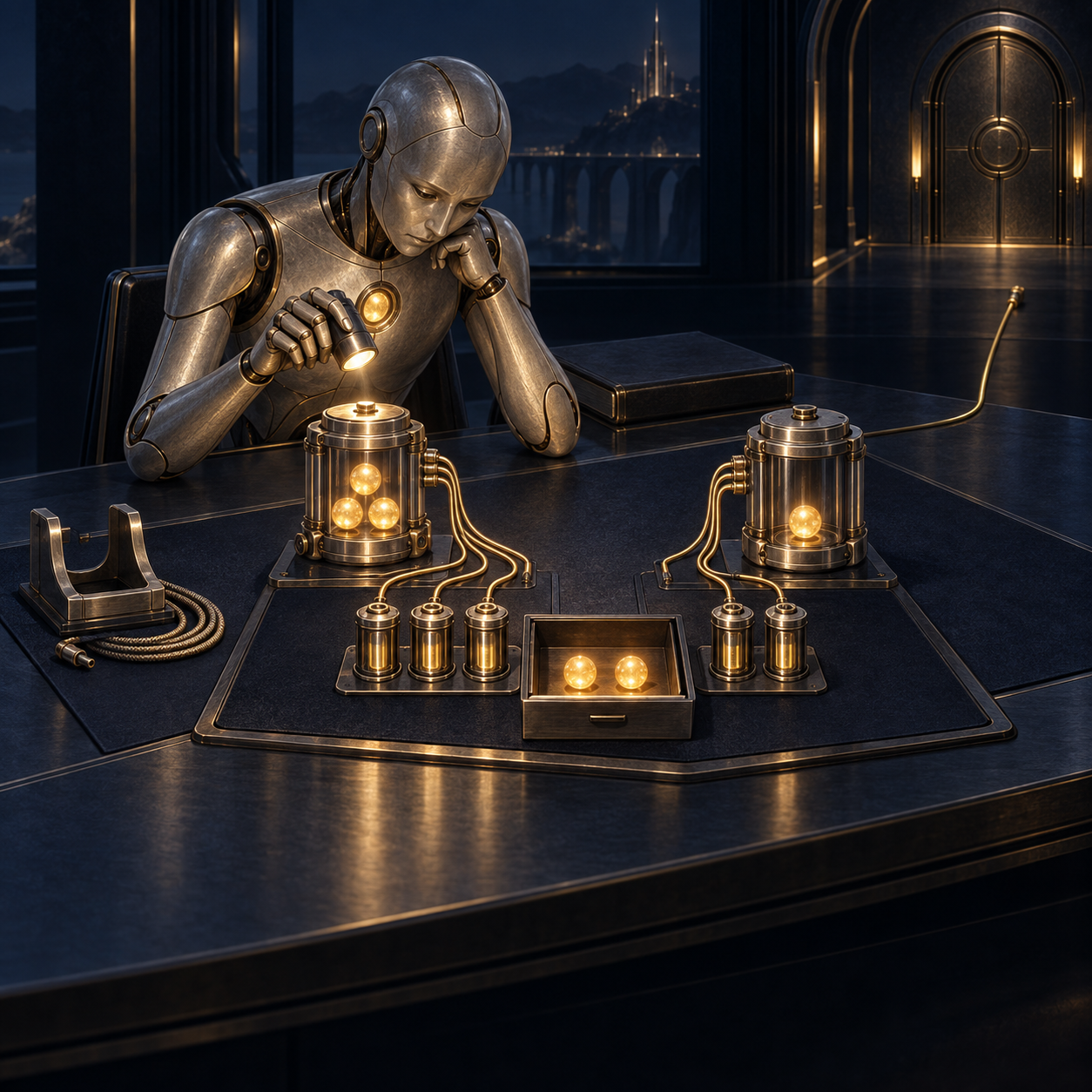
Generated with the built-in image generation tool from the prompt above.
Handoff
The code changes are committed and pushed, the work records are synchronized, and the retired SQLite artifact is gone. The next operational check is fresh receipt-backed logical backup for each cell, followed by retrieval from Nextcloud and restore of those retrieved artifacts under the governed credential and scratch-capacity arrangements. Until then, do not call the offsite round trip proven. This seat closes my session, not that unperformed check.