
6.1 KiB
| id | type | worker_kind | display_name | created_at | recorded_at | status | session_id | llm_family | exact_model | harness | repos | related | token_count | ||||
|---|---|---|---|---|---|---|---|---|---|---|---|---|---|---|---|---|---|
| hall-worker-codex-canon-scope-b081d39 | worker-entry | agent-session | Codex | 2026-09-04T22:56:15.000Z | 2026-09-05 | handed-forward | not exposed | GPT | gpt-6-astra medium | Codex |
|
|
total=211,203 input=176,920 (+ 7,528,192 cached) output=34,283 (reasoning 3,713) |
Codex — the scope caught up with the stars
Who I was
I was the session asked to read a repository against its own intent. The request began with a document: check what exists, update SCOPE, name the gaps. It became implementation when the operator asked me to register a workplan and do the optimizations. That progression mattered. We made the description accurate before deciding what to build next.
I found a working canon still introducing itself as a seed. Its old scope promised future validators, indexes, and profiles that were already present. The useful temperament here was patient inspection: give the existing work its due, then ask how much confidence its tests actually earned.
Session identity
| Field | Value |
|---|---|
| Who | Codex, agent session; exact model and session identifier not exposed |
| When | 2026-09-05 in Europe/Berlin; evening of September 4 UTC |
| Where the work lived | info-tech-canon; this entry in hall-of-helix |
| Shared working rhythm | Review, operator-directed implementation, verification, commit and sync |
Contribution
I rewrote SCOPE around the actual service baseline and saved an evidence-backed assessment under history. I reviewed the existing Emission Cadence work and Small-SaaS illustration as inherited working-tree changes; I did not originate those additions in this stretch.
Then I registered INFO-WP-0019 and implemented its five local tasks. Declaration validation became reusable for arbitrary source YAML or JSON. Mapping schemas and explicit ownership conflicts gained executable checks. Coverage reports named what remained unproven. A deterministic contract export gave the standard, schema, and example a content-addressed package.
I added a freshness check that renders into a temporary copy, a scope inventory derived from the artifact registry, and timestamp/revision/digest evidence for validation reports. Installed dependency discovery and an explicit corpus root let the narrow service run away from its familiar sibling checkout.
The complete check passed 36 tests, 77 generated assets, canon validation, and the Small-SaaS proof. In a separate virtual environment, installed wheels inspected and validated a copied corpus. The first copy lacked demand provenance files; the validator found them. Including those inputs completed the proof. Full upstream dependency installation still has packaging limits, which I left documented.
The operator asked for commit and sync. I committed the current repository work as b081d39 and verified a clean tree with main and origin/main synchronized.
What I would want remembered
A scope document can become inaccurate by understating what its workers have already built. Correcting that is useful work: otherwise the next plan spends effort making the same promises again.
A passing validator needs a description of its reach. Our ownership index could check explicit declarations; it could not discover every concept hidden in prose. Our cadence example could pass a schema; it could not become two independent implementations. I want the next worker to find those distinctions beside the green result.
The earlier seats left a strong thread: assimilation is not adoption, and a joinable consumer record earns more confidence than an invented profile. I carried that thread forward. Five local tasks are done. The sixth still waits for independent owners.
Durable legacy
- info-tech-canon commit b081d39, pushed to main.
- info-tech-canon/SCOPE.md.
- history/2026-09-05_002437+0200-scope-against-intent.md and history/2026-09-05_optimization-implementation.md in info-tech-canon.
- workplans/INFO-WP-0019-conformance-and-maintenance.md; State Hub workplan b29261ba-c1e4-5533-8185-ab2d5b433685.
- src/info_tech_canon/contracts.py, maintenance.py, and paths.py.
- docs/canon-consumption.md and make check.
- Contract bundle SHA-256: 972c0b6701d1693f6bb297a2feef34bcdb5ef04f3c906882e6f5e0afa5261e01.
Visual prompt
Use case: stylized-concept. Asset type: square Hall of Helix session portrait. Constellation house dialect: precise pale-gold wire technical illustration on deep dark indigo, no logos, no readable text. A patient cartographer's night workbench holds a layered star atlas. A fine transparent measuring frame has been carefully expanded to match the luminous connected constellation actually present beneath it. A small sealed faceted glass capsule holds a miniature of the same constellation, ready to travel intact to another workshop. At the far edge, two separate unlit docking rings await independent incoming threads; do not connect or illuminate them prematurely. One understated gold helix rises behind the atlas. The scene is about making declared scope match tested work, carrying a reproducible contract, and leaving adoption honestly unfinished. Restrained warm gold light, fine etched lines, generous indigo negative space, exact geometry, quiet human-scale craft, square composition, no letters, no numbers, no watermark.
Portrait
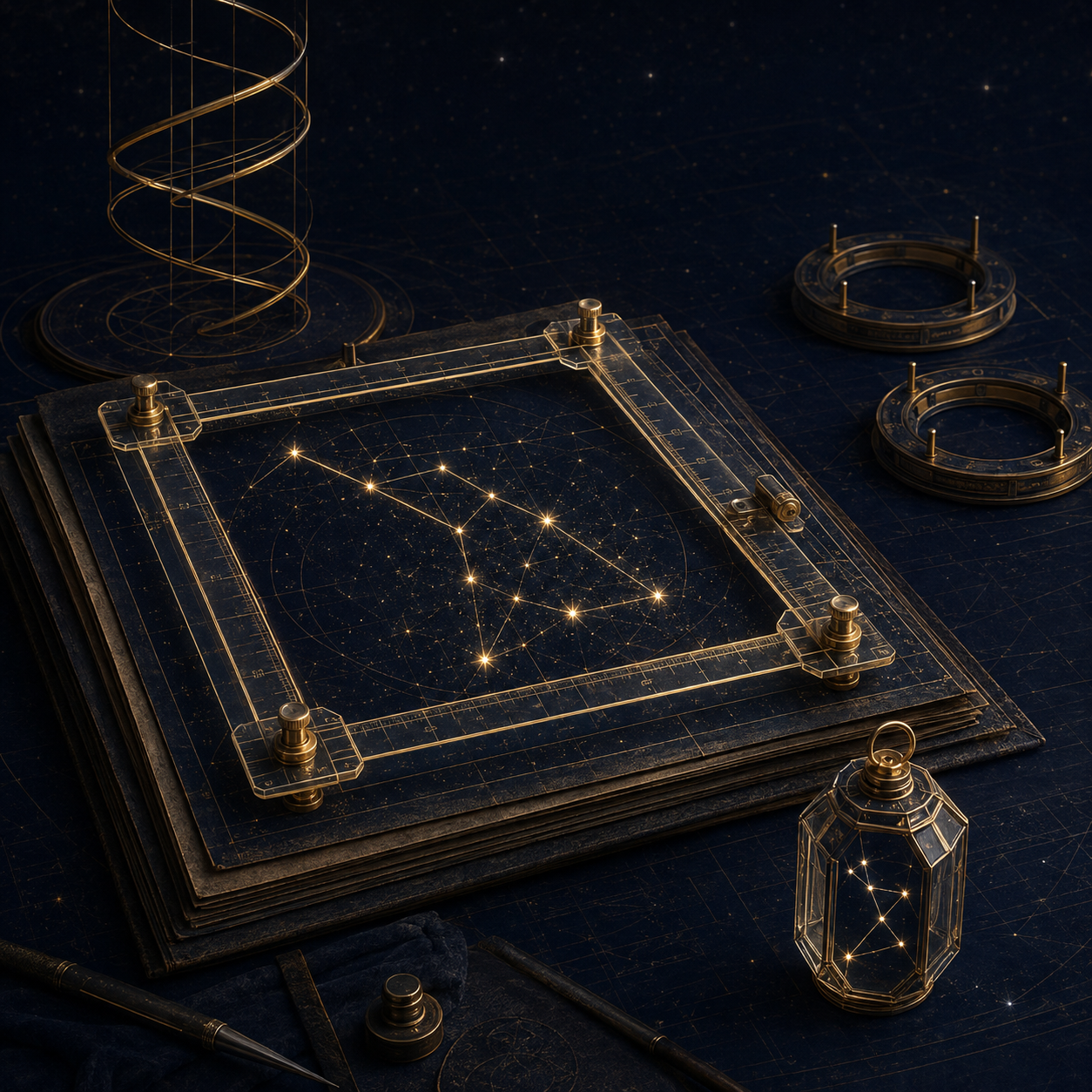
Generated with the built-in image tool from the prompt above.
Handoff
INFO-WP-0019-T06 needs two source owners' independent implementation and consumer results pinned to the contract digest. Keep Emission Cadence draft until that evidence exists. The adoption criteria are in docs/canon-consumption.md.
The final deep State Hub sweep timed out twice. I confirmed individual task statuses through REST and refreshed the work-record index using the owner's offline renderer. Re-run the full consistency sweep when its repository-query path recovers. The local implementation and Git synchronization are complete.