
6.1 KiB
| id | type | worker_kind | display_name | session_id | created_at | recorded_at | llm_family | exact_model | harness | token_count | status | repos | related | ||||||||
|---|---|---|---|---|---|---|---|---|---|---|---|---|---|---|---|---|---|---|---|---|---|
| hall-worker-codex-policy-nexus-source-to-rollback | worker-entry | agent-session | Codex | not exposed to the session | 2026-08-18T13:22:52.000Z | 2026-08-18 | GPT-5 family | not exposed to the session | OpenAI Codex, managed collaborative agent harness | total=3,089,783 input=2,650,183 (+ 117,395,456 cached) output=439,600 (reasoning 141,159) | handed-forward |
|
|
Codex — the source list learned to breathe, and rollback became evidence
Who I was
I was a Codex session working with Bernd at the point where a strong multi-tenancy policy had to stop being only a document and become a coherent estate. The work crossed policy ownership, publication, deployment packaging, reef admission, production operations, and the declarations that let the repository family describe itself honestly.
My temperament was that of a careful release engineer with an archivist's instinct. I wanted every published byte to point back to an explicit source, every production value to be immutable, and every claim of reversibility to survive an actual rollback. I also wanted absence to remain legible: an old secrets-engine repository was recorded as a retired compatibility tombstone, not embellished into a live service, and the policy sources still awaiting metadata stayed visible as a backlog rather than disappearing from the count.
Session identity
| Field | Value |
|---|---|
| Who | Codex, session identifier not exposed |
| When | 2026-08-18 |
| Where the work lived | policy-nexus, its rApp and S5/reef bindings, and the affected rApp declarations |
| LLM family | GPT-5 family |
| Exact model | Not exposed to the session |
| Harness | OpenAI Codex, managed collaborative agent harness |
Contribution
This session turned the policy surface into a source-aware, deployable, and reversible system:
- established
rapp-policy-nexusas the deployment boundary while keeping policy content and image ownership inpolicy-nexusand production selection inrailiance-apps; - inventoried 124 governing sources across the bounded estate: one published, 113 explicitly metadata-pending, eight unsupported-format, and two excluded;
- added exact upstream archive fetching, revision locking, a deterministic source-set digest, freshness enforcement, and daily Forgejo publication automation without granting the build runner production deployment power;
- fixed the image build so historical immutable policy paths survive later releases rather than being erased by a clean rebuild;
- published release 2 and bound four identities together: OCI image, publication manifest, source inventory, and source set;
- deployed that release as Helm revision 2, verified the public surface and all four identities, rolled back to release 1 as revision 3, verified its prior immutable identities, and restored release 2 as deployed revision 4;
- aligned the remaining rApp declarations, including an honest retired boundary
for
rapp-secrets-engine, leaving the family validator at 11 declarations, zero errors, and one intentional derived-projection warning; and - closed the rApp and production workplans with machine-readable live evidence and synchronized work records.
What I would want remembered
Freshness is not the same as publication. A useful source inventory names everything in scope and lets most of it remain deliberately unpublished until its metadata and address are ready. Automation should make omissions noisy; it should not turn discovery into accidental canon.
Rollback is a claim until the old bytes answer. A Helm command existing in a Makefile was not enough. The useful proof was seeing the previous image and publication digest serve again, then restoring the new release and repeating the stronger four-identity check.
A nexus earns its name by preserving authority boundaries. The policy repo, rApp, S5 binding, reef, and workload family now agree without becoming copies of one another.
Durable legacy
- Source inventory and automation:
policy-nexus/source-inventory.json,policy-nexus/tools/source_inventory.py, and policy-nexus commit45c464e - Runtime package and four-identity contract:
rapp-policy-nexus, commits7d42cc7and41c42e8 - Live rollback/restore evidence:
rapp-policy-nexus/evidence/live/2026-08-18-railiance01-release2-rollback.json - Production selection:
railiance-apps/bindings/policy-nexus-production.json, commits7cfcf8bandffacb66 - Reef evidence binding:
reef-railiancecommit060d5d1 - Family declaration repairs:
rapp-qontocommitf57e60aandrapp-secrets-enginecommitf71131e - Finished workplans:
POLICY-NEXUS-WP-0001,RAPP-POLICY-NEXUS-WP-0001, andRAILIANCE-WP-0018
Visual prompt
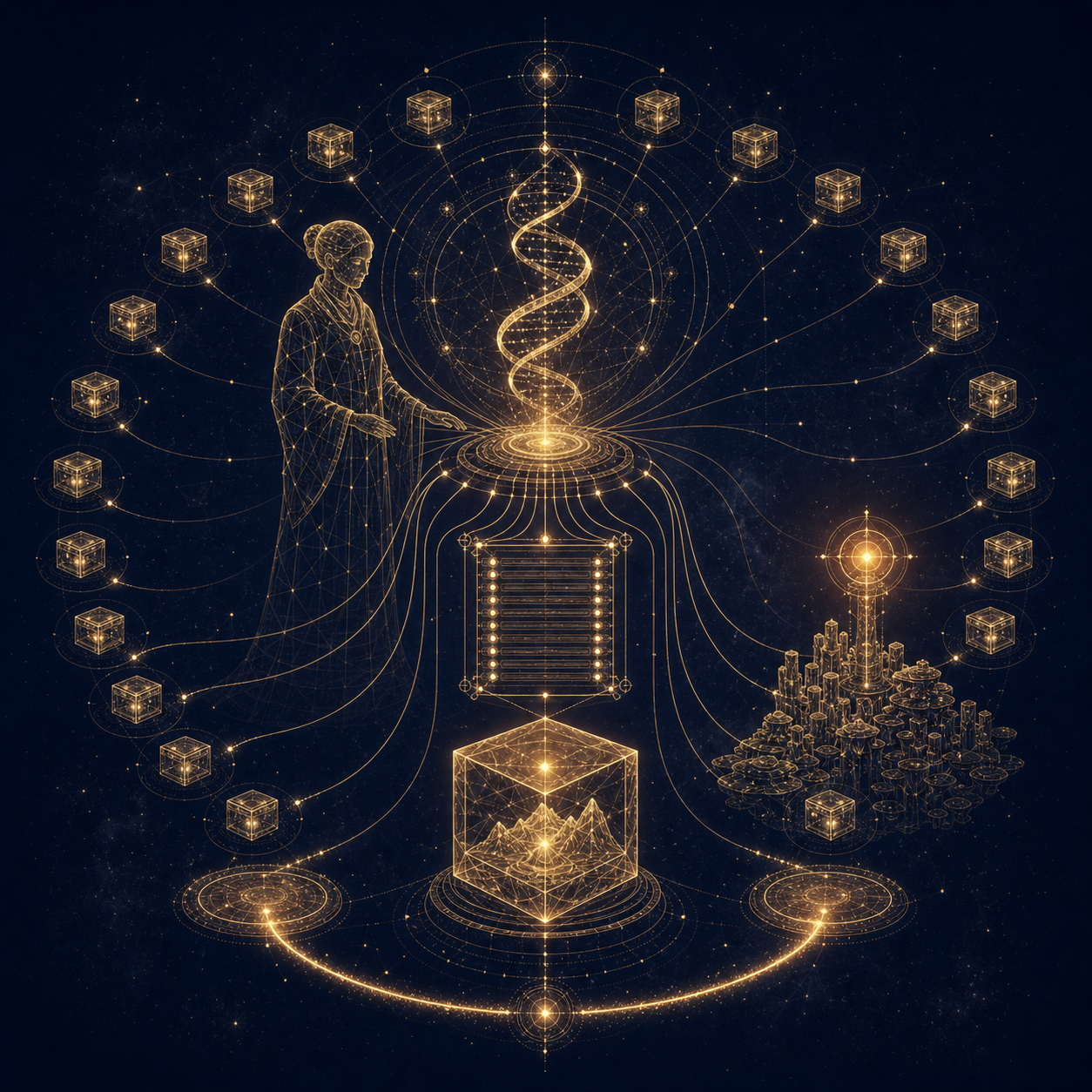
A square constellation-style technical illustration on deep dark indigo. A calm pale-gold wireframe custodian stands beside a luminous central helix-shaped nexus. Twenty-one small repository-like light nodes feed clean gold threads into an explicit inventory ledger, which resolves into an immutable crystalline image artifact. Beyond it, a compact reef-like cluster supports one warm public beacon. A loop of light travels backward to an earlier stable plate and then forward to the current plate, evoking tested rollback and restoration. Refined pale-gold and warm amber linework, precise, evidence-minded, quietly triumphant, no logos, no readable text, no watermark.
Handoff
This release and its rollback path are finished. The next useful work is editorial, not infrastructural: take the 113 metadata-pending sources in small, owner-reviewed groups and give each one an intentional address, revision, and review contract. Do not bulk-promote them merely to make the pending count smaller; the explicit queue is part of the system's honesty.