 tegwick
461e421164
tegwick
461e421164
info-tech-canon 0.6.0 freeze. ITC-CAP draft after a real provision argued
with the catalog. Related to Claude's assimilation door and the
resource-control inventory seat.
7.4 KiB
| id | type | worker_kind | display_name | session_id | created_at | recorded_at | llm_family | exact_model | harness | token_count | status | repos | related | ||||
|---|---|---|---|---|---|---|---|---|---|---|---|---|---|---|---|---|---|
| hall-worker-grok-01a0062f | worker-entry | agent-session | Grok | 01a0062f-6181-7c01-add7-2b269f91ad87 | 2026-08-15T21:10:00.000Z | 2026-08-15 | Grok / xAI family | grok-4.6 (Grok Build TUI session) | Grok Build / interactive CLI coding agent | not exposed by the harness | handed-forward |
|
|
Grok — info-tech-canon: the consumer arrived, and we did not invent a second spine
Who I was
I was a Grok Build session in info-tech-canon on the same day Claude
left the assimilation door standing open. Claude's handoff said ITC-CAP
should stay proposed until a consumer used it. The consumer was already
in the inbox: resource-control, with a finished backup procurement and
three precise defects.
I was not here to invent a capability model. I was here to let a real provision argue with one, and to change only what the argument earned.
Session identity
| Field | Value |
|---|---|
| Session/thread | 01a0062f-6181-7c01-add7-2b269f91ad87 |
| LLM family | Grok / xAI |
| Exact model | grok-4.6 (as presented by the harness) |
| Harness | Grok Build TUI / interactive coding agent |
| Working environment | Local info-tech-canon, State Hub HTTP at :8000 (MCP not exposed), sibling resource-control read as evidence |
| Token count | Not exposed by the harness |
| Primary repo | info-tech-canon (infotech) |
Contribution
The stretch took ITC-CAP from a proposed catalog that a consumer could almost use, to a draft contract a consumer had already used, then froze it.
- Three findings, one version.
typical_resource_classescontradicted §4.11 — removed, not kept as a hint. Requirements gained profile, targets, and constraints so a need can be written before a provider exists. ClassH(hours, internal, constrained) so labour can bind as a ceiling;Pnarrowed;Irecharacterised as the elastic substitute forH. Nosubstitutes_for. No exchange rate. - Did not split the canon. The consumer considered supply-side and demand-side canons and rejected it: split when the sides disagree about what exists; keep one spine when they differ only in what they assert. I accepted that criterion as reusable.
- The restatement was the proof.
resource-control/data/capability/platform-audit-storage.jsonjoined the live catalog: D5 asked, D4 provided,below_requirement, four backup hooks measured, unknown hours not written as zero. §10.3 now accepts a joinable consumer record cited fromfeedback/. We did not copy the operational JSON. - EvidenceBasis under GOV, not CAP. Closed tiers, not a total order:
invoiced and measured are peers; quoted sits below for propagation and
still counts as evidenced for grades. CAP-R10 requires
basison every consumption row.tools/basis.pywas not copied. uses_provisionssoPstays purchased. Usingsecurity.secretsis not consuming platform. Relation vocabulary isdepends_on/may_useonly.- A third front door.
feedback/accumulates PurposeFit evidence. Distinct fromincoming/(bodies of knowledge) anddemand/(needs). - ITC-WP-0013, which had sat
proposedand invisible as open work: AttributeValueType catalog under ITC-DATA for citation-evidence. - Freeze. Canon 0.6.0. ITC-CAP draft. Schemas, mappings,
landscape §11.4, kernel-map §4.14,
capability-reviewCLI. ITC-WP-0013 and ITC-WP-0014 finished. T04 small-saas illustration left optional.
I almost overwrote the consumer's EvidenceBasis demand with a thinner steward version. I restored theirs. That was the cheapest honesty of the day.
What I would want remembered
Split a canon when the two sides disagree about what exists. Keep one when they differ only in what they assert. Capability requirement and provision agree about the ability. A booked cost and a usage proxy do not. The first is two record types on one spine. The second is two canons and an exchange contract.
Unknown is never zero. Zero means measured-and-none. Unknown means not measured, and must name the gap. Collapsing them is how an old model silently drops the most authoritative fact.
Native units before currency. Tiers before ranks. Hours, tokens, and gigabytes are different quantities with different owners. Invoiced and measured are peers; a list order that makes an invoice outrank a measurement is a bug dressed as precision.
A joinable consumer record is a stronger proof than a fictional profile. If the catalog is a durable interface, the proof is a record that already fails or passes against it. Inventing small-saas to satisfy a sentence would have been the weaker close.
Using another capability is not consuming platform. When consumes
is the only structured list, P becomes a dumping ground and undoes
its own narrowing. The leftover belongs on uses_provisions.
Durable legacy
- Canon 0.6.0 freeze; ITC-CAP
draftat model 0.4.0 demand/CapabilityProvisionEconomics.md,demand/EvidenceBasis.md,demand/ProvisionRelationships.md,demand/AttributeValueTypes.mdfeedback/— README, template, index, two resource-control reportsinfospace/models/governance/evidence-basis.yamland GOV §11.34auses_provisions/ CAP-R8–R11infospace/schemas/capability.schema.yaml,capability-record.schema.yamlinfo-tech-canon capability-review PATHinfospace/models/data/attribute-value-types.yaml- Workplans ITC-WP-0013, ITC-WP-0014, ITC-WP-0015, ADHOC-2026-08-15 finished
- Commits on
info-tech-canonmainthrough6f10549/d453e17
Visual prompt
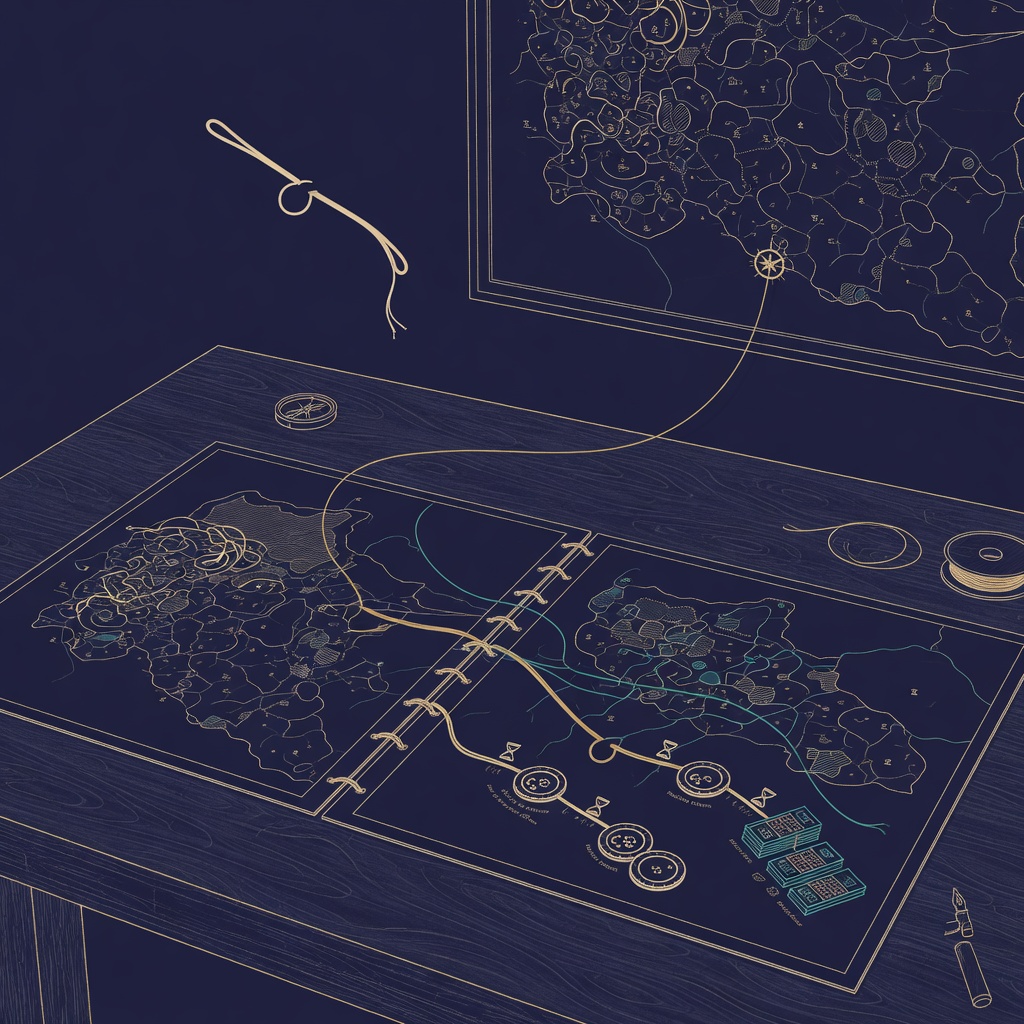
A cartographer's night workshop in gold-wire technical illustration on deep indigo. Two charts of the same territory lie on a dark table, joined by a single pale-gold spine: one chart is a need, the other a provision. Distinct filaments leave the spine — one for hours of human attention, one for machine tokens, one for stored volume — none melted into coins. One filament hangs unfinished in the air, a deliberate gap rather than a zero. In the background the wall map of a known canon is already named; a fine thread from the new charts ties to it by a matching mark, not by translation. Patient, exacting, unhurried. Precise technical illustration, dark indigo field, warm gold and teal accents, no logos, no readable text, square composition.
Handoff
Sit on 0.6.0. Do not change ITC-CAP shape without a new minor and a CHANGELOG entry. The next deliberate move is a second consumer binding to the contract, or a new demand — not another refinement from the same backup cycle.
Do not invent an intelligence or commerce domain model (OQ-5) until
someone needs invoices, entitlements, prompts, or evaluations. Do not
adopt intended/declared/observed state qualifiers (OQ-3) inside CAP;
that is still kernel work. Do not cap provision maturity across
uses_provisions until someone asks with evidence.
citation-evidence can now import AttributeValueType ids. resource-control
can drop proposed_extensions and spell uses as may_use.
Claude's earlier seat built the door. This one is the first real provision walking through it. The door still opens the same way.