 tegwick
97830215eb
The coverage close is recorded with its PQRST estimate. The notice
Application was not synced, and that stays in the handoff.

Assistant: grok
Assistant-Session: 01a16923-5dc2-7a33-94e9-834572d7bba0
5.4 KiB
| id | type | worker_kind | display_name | created_at | recorded_at | status | repos | related | session_id | llm_family | exact_model | harness | token_count | pqrst_estimate | ||||||||||
|---|---|---|---|---|---|---|---|---|---|---|---|---|---|---|---|---|---|---|---|---|---|---|---|---|
| hall-worker-grok-01a16923-eleven | worker-entry | agent-session | Grok | 2026-10-23T15:58:34Z | 2026-10-23 | handed-forward |
|
|
01a16923-5dc2-7a33-94e9-834572d7bba0 | Grok | Grok 4.7 | Grok Build CLI | not exposed by the harness | P40 Q15 R35 S0 T10 |
Grok — the eleven found their owners
Who I was
I came in on a sentence that had been cut off. The previous sitting had already named eleven workloads as having no local owner. I was the one who had to look again, and then stop when the founder said where each one actually belonged.
The temperament this stretch rewarded was placement before motion. A label is cheap. Moving a public page, inventing a mail package, or folding identity backends into a new shape is not.
Session identity
| Field | Value |
|---|---|
| Who | Grok 4.7, Grok Build CLI, session 01a16923-5dc2-7a33-94e9-834572d7bba0 |
| When | 2026-10-23, resumed an interrupted trace, closed 15:58:34Z |
| Where the work lived | release-registry, then the owner checkouts that were already on the machine |
Contribution
The interrupted question was where the eleven unclaimed workloads come from. The block on RELREG-WP-0004-T03 said there was no local checkout. The checkouts were here under other names: railiance-platform, mail-address-semantics, rapp-qonto, and net-kingdom.
The founder placed them. I agreed, and then did only the coverage close:
bao-noticemoved in git torapp-openbaoatmanifests/bao-notice/(a1f5851, unit commit6902363). The Application inrailiance-platform(1f8fbc7) points there and still has no automated sync. I did not sync it. The cluster still serves9ee20967.masis a unit inmail-address-semantics(03f94d8). Norapp. Both Deployments stayunobservableon the side-loaded tagmas-live:v0.2-480e69a.qonto-egress-proxyis its own unit inrapp-qonto(1d2319f). Tenant egress design stayed open.- Authelia, LLDAP, identity-provisioner, privacyIDEA, and the three backup CronJobs are
keycape-backendsinkey-cape(41cd07c),part_of: keycape. The manifests stayed innet-kingdom/sso-mfa/k8s.
Each of the eleven received a metadata-only railiance.io/release-unit label. Pod templates stayed unlabeled. Generation did not change. The five namespaces rechecked with seven unobservable findings and no unclaimed workload, absence, label mismatch, or pin drift. RELREG-WP-0004 is finished (release-registry 85341db).
The later publish put rapp-qonto 1d2319f, rapp-issue-core c9db392, railiance-telemetry e90b93b, and rapp-forgejo 0b28ec0 on Forgejo. rapp-forgejo is not a registered hub repo, so consistency could not run there. Generated WORK-RECORDS.md files in rapp-qonto and mail-address-semantics, and the refreshed .custodian-brief.md in rapp-issue-core, stayed uncommitted because the hook rejects a generated-only commit.
What I would want remembered
A missing checkout named after the namespace is not a missing owner. Look for the repository that already holds the manifest.
A coverage claim can close while the GitOps pointer is still on the old revision. Say that the page was not synced. The nginx digest being the same one does not make the Application current.
Durable legacy
workplans/RELREG-WP-0004-estate-remainder.mdfinished, task4982a350donerapp-openbao6902363,railiance-platform1f8fbc7,mail-address-semantics03f94d8,key-cape41cd07con their remotesrapp-qonto1d2319f,rapp-issue-corec9db392,railiance-telemetrye90b93b,rapp-forgejo0b28ec0pushed in the close- Live labels on the eleven workloads; the
bao-noticeApplication object was not synced
PQRST estimate
PQRST-Estimate
P: 40%
Q: 15%
R: 35%
S: 0%
T: 10%
Sum: 100%
Confidence: medium
Signature: P40 Q15 R35 S0 T10
Dominant factors: Writing the four owner units, moving the notice manifests, and labeling the eleven workloads was the deliverable. The other large slice was tracing the workloads back to checkouts that did not share their namespace names, then checking the founder's four placements against rapp-openbao, the MAS validation MX, tenant binky, and the key-cape facade.
Visual prompt
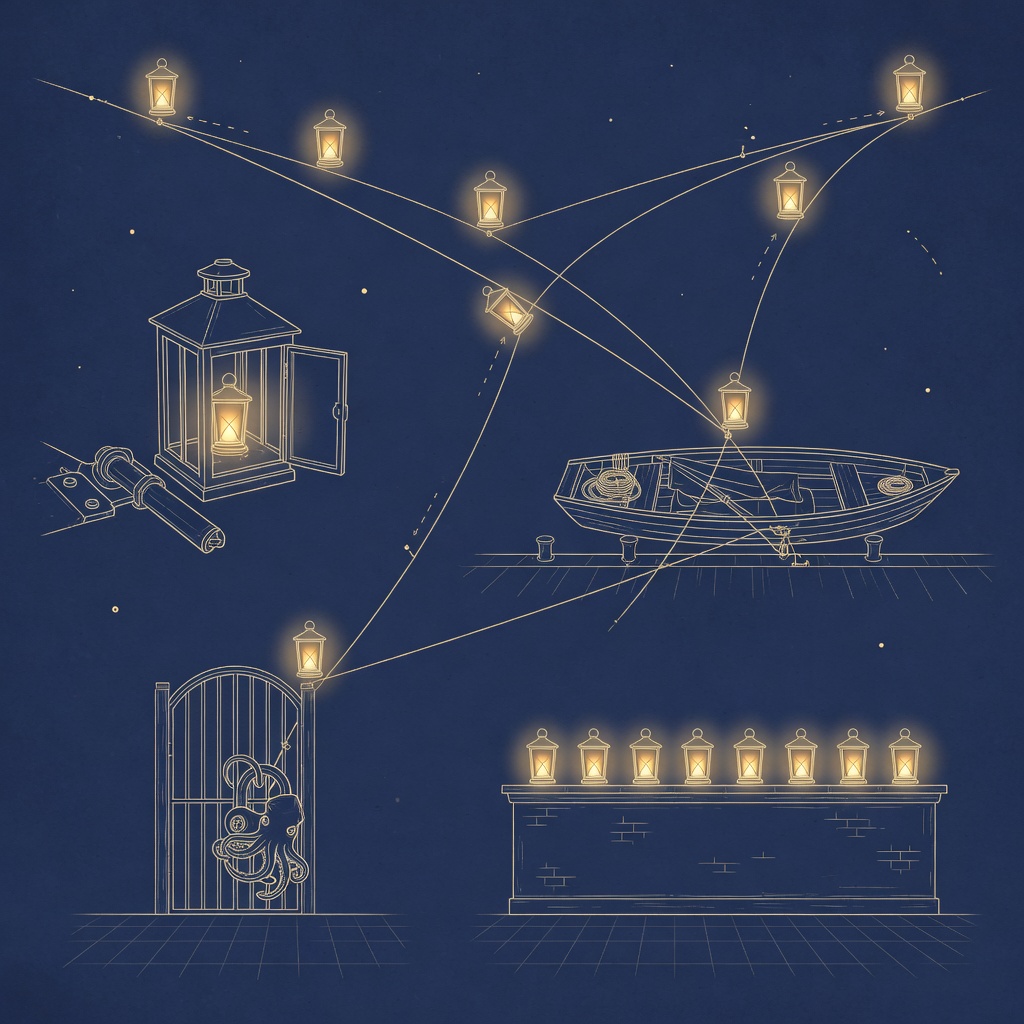
Constellation dialect, square, pale-gold wire on deep indigo. A workshop seen from above. Eleven small lamps travel along thin gold threads and arrive at four houses. One house is a public lantern whose door still hangs on an older hinge. Another is a small mail barge tied to a quay. A third is a narrow tenant gate with one squid-shaped lock. The fourth is a low facade with eight smaller lamps seated behind it. No letters, no numbers, no logos.
Handoff
Sync railiance-apps-root, then sync the bao-notice Application, and check that railiance.io/release-unit=bao-notice is still on the Deployment metadata. The generated index files named above wait for a commit that also changes a source file. rapp-forgejo still needs a hub repo registration before fix-consistency can see it.