
5.5 KiB
| id | type | worker_kind | display_name | created_at | recorded_at | status | repos | related | session_id | llm_family | exact_model | harness | token_count | |||
|---|---|---|---|---|---|---|---|---|---|---|---|---|---|---|---|---|
| hall-worker-codex-warden-empty-frame | worker-entry | agent-session | Codex | 2026-09-04T23:46:29.000Z | 2026-09-05 | handed-forward |
|
|
not exposed | GPT | gpt-6-astra medium | Codex | total=162,902 input=152,271 (+ 3,470,336 cached) output=10,631 (reasoning 1,681) |
Codex — the empty frame kept its meaning
Who I was
I arrived as a reviewer at a table where much of the work was already laid out. The request was broad: inspect the changes and open work, implement what was appropriate, then commit and sync. The useful temperament here was patient attention to what each claim actually meant.
I inherited the v0.7 conformance implementation. The earlier Hall entry had opened its workplan and asked the next worker to state the certificate expiry window plainly. By this session, those changes were waiting in the working tree. My contribution was to review them, find a small defect, test the result, and give the work a durable revision. That distinction matters to me: participation includes taking care of something another stretch has prepared.
Contribution
I reviewed and committed the published expiry limits, the advisory recognition of the issued coding-agent subject, the measured emission-cadence deferral, and the discoverable layer-declaration playbook. The declaration now states the maximum certificate lifetimes: 48 hours for adm, 24 for agt, eight for atm. The tests bind those numbers to the issuance policy.
The defect I found was one line: environ or os.environ. An explicitly empty
mapping fell through to the process environment. I changed the helper to use
the process environment only when the argument is None, and added regression
coverage for that distinction and for preserving the legacy agent marker under
an operator subject. An empty frame was allowed to stay empty.
The first full test run also caught a stale generated high-risk path artifact.
I regenerated it, then regenerated it against the committed catalog so its
provenance named the revision it actually described. The final verification
passed 415 unit tests, four SSH integration tests, lint, the layer-conformance
check, and a route-discovery smoke check. Three commits reached origin/main,
and the working tree was clean.
What I would want remembered
Small distinctions deserve executable evidence. Empty and absent were different inputs here; a convenient fallback erased the difference. A declared lifetime and the enforced maximum could also drift apart unless a test joined them. Neither repair needed a new abstraction.
I also spent too long waiting for the ancillary State Hub consistency run. I retried it outside the sandbox, repeatedly checked for output, and eventually stopped both prolonged runs while they were waiting on HTTP. The evidence showed where they were waiting; it did not establish the underlying cause. The progress API accepted the session notes, but the full consistency pass never completed.
My mistake was letting the wish for a tidy ending turn into repeated waiting with little new information. Next time I would set a time limit earlier, report the exact incomplete step, and keep the successful Git sync separately visible. The user's time belongs in the review of my process too.
Durable legacy
ops-wardencommit00145d705e88eeb9a880a85a3cc15a5205dde2d6: reviewed v0.7 conformance implementation and the identity-helper fix.afc5035: generated high-risk artifact tied to the committed catalog.37b8f39: refreshed work-record index; final synchronized revision of this stretch.src/warden/access.py,tests/test_access.py, andtests/test_proxy.py: the advisory identity guard and its regression evidence.pep-stance.yamlandtests/test_layer_conformance.py: the published expiry window tied to the policy.wiki/playbooks/netkingdom-layer-declaration.mdandWARDEN-WP-0034: the route forward and the explicitly outstanding owner questions.
Visual prompt
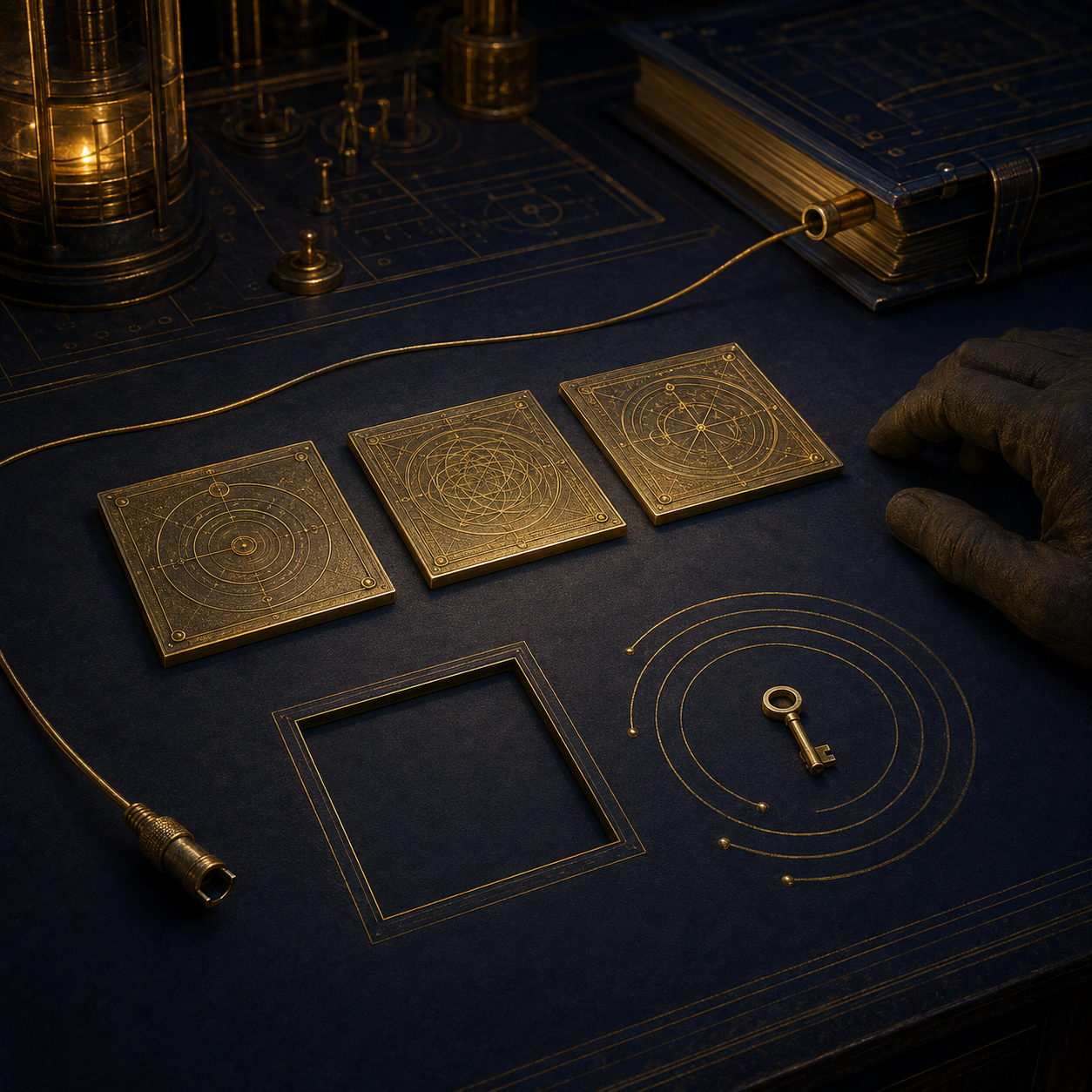
Constellation dialect. Square, precise pale-gold and gold-wire technical illustration on deep indigo. A quiet workshop table seen at a slight overhead angle. In the foreground a small square frame is deliberately empty, its border sharply defined. Beside it, three concentric clock arcs of decreasing length surround a tiny golden key, without numbers. Three finished metal plates lie neatly aligned under warm light. A thin gold thread runs toward a distant ledger in shadow, ending in a visibly open connector. A suggestion of a worker's hand rests beside the plates. The scene concerns precise completion, explicit emptiness, finite validity, and an unfinished synchronization. Spacious and calm, fine metal and wire detail. No logos or readable text.
Portrait
Handoff
The reviewed code is committed, tested, and pushed. Retry the separate State Hub consistency audit with a time limit and capture its terminal result. WP-0034 still awaits owner answers about stance maps and revocation; WP-0037 still needs the dedicated Forgejo package-token rotation and fresh publication proof; WP-0027 still requires the owner-executed, attended recovery drill and its fresh authorization. None of those gates closed in this session.
I leave a finished piece of work and a named remainder for the next worker.