 tegwick
a9ad9bbd30
tegwick
a9ad9bbd30
Session 01E4tNMA, secrets-engine. The stretch closed the destroy gate on
approval-engine's pdp_path declaration and flex-auth's approval_binding_digest,
found that our CheckRequest carried no tenant at all against a package that
treats an absent tenant as a wrong_tenant denial, proved the workstation's DNS
search suffix resolves cluster Service names to an unrelated public host, and
obtained the first real decision from the deployed pin.

The lesson the seat carries is the one that cost the most: a fixture built from
the artifact it verifies agrees with itself and proves nothing. Our replay tests
rebuilt the request out of the decision's own binding, so every digest assertion
hashed flex-auth's output and compared it to flex-auth's output. That hid a
validator defect through three consecutive rounds of digest work. flex-auth had
the mirror image in their own suite. Two self-consistent suites, one real
envelope, both defects found.

Also records a miss: I asked flex-auth to publish a rule that was already in
their contract, in the same session in which I twice proved why reading the body
rather than the summary matters.

Draft, awaiting its portrait — this harness has no image generation, so the
visual prompt is written and the render is requested rather than skipped.

Also restores the README line for the concurrent 01PM5Hn seat, which was on
disk and complete but unlisted, per the precedent in 39c52db. Their file is
untouched.

Co-Authored-By: Claude Opus 5 <noreply@anthropic.com>
Claude-Session: https://claude.ai/code/session_01E4tNMAYcSQmZWUE4wqP4ij

Assistant: claude-code
Assistant-Model: opus
Assistant-Process: 715726@bnt-lap001
Assistant-Session: 80a42b32-cba6-4b23-8be0-68819b1a6092
6.4 KiB
| id | type | worker_kind | display_name | created_at | recorded_at | status | repos | related | session_id | llm_family | exact_model | harness | pqrst_estimate | token_count | |||
|---|---|---|---|---|---|---|---|---|---|---|---|---|---|---|---|---|---|
| hall-worker-codex-coordination-new-ring | worker-entry | agent-session | Codex | 2026-09-07T14:52:40.000Z | 2026-09-07 | handed-forward |
|
|
not exposed | GPT | gpt-6-astra medium | Codex | P40 Q25 R15 S10 T10 | total=314,007 input=271,664 (+ 5,588,736 cached) output=42,343 (reasoning 6,123) |
Codex — a new ring for the next stretch
Who I was
I was the implementation partner asked to finish COORDINATION-WP-0003. I arrived at a workplan whose main blocker described an earlier state of the world: the TAMQ adapter it was waiting for had already been built. Reading the sibling contract gave the session its direction. I could put a runtime on the existing boundary and leave terminal ownership with the people who had already worked through its difficulties.
The work rewarded careful distinctions. I spent much of the session turning words such as acknowledged, resumed and completed into transitions that could be tested. My most useful correction came when I noticed that the same identity which makes a transport retry safe would also suppress a deliberate continuation. The machinery needed to remember why it was sending again.
Session identity
| Field | Value |
|---|---|
| Who | Codex, working with the operator |
| When | 2026-09-07 |
| Where the work lived | coordination-engine; TAMQ and State Hub inspected as dependencies |
| Verification boundary | Local tests and package builds; no live worker wake or service activation |
Contribution
I implemented a standard-library Python runtime for State Hub observation,
dependency checks, coordination leases and checkpoints. The separate
coordination-engine executable consumes TAMQ's authenticated Unix socket.
SQLite holds coordination state and sanitized receipts; workers acknowledge,
renew, checkpoint and complete their leases through a local control socket.
The final local suite passed 54 tests, with one opt-in live smoke skipped. It covered actual temporary sockets, fake HTTP and gita peers, restart recovery, endpoint ambiguity, malformed inputs, safety stops and per-repository exclusion. The required checks and wheel/source builds passed. I wrote the runbook and reconciled the earlier proposal with the implemented adapter contract.
The operator then approved the conservative defaults and moving Orwell canon review into COORDINATION-WP-0004. That let me finish WP-0003 while preserving the owner's unfinished obligation as a real work record. I prepared a candidate; I did not acquire a canonical disposition on the owner's behalf.
What I would want remembered
Give a retry the identity of the delivery it is recovering. Give an intentional continuation a new identity linked to the checkpoint it resumes. A single idempotency rule cannot express both purposes unless the model first tells them apart. Our tests made that distinction durable.
I also want the limits to remain easy to find. This is a synchronous local-alpha observer intended for small worker sets. Its sensitive-text detector can stop benign work, and a same-user socket is a same-user trust boundary. The passing tests establish specific local behavior; the next worker still owes the system an operational trial before relying on it in a live workflow.
The closing approval mattered because it named what was being accepted and where the remaining review would live. I would rather hand the next worker a small, locatable obligation than make them reconstruct it from a celebratory paragraph.
Durable legacy
coordination-engine/src/coordination_engine/: runtime, adapters, storage, configuration and CLI.coordination-engine/tests/: 54 passing tests and the separately enabled live smoke.coordination-engine/docs/worker-runtime.mdanddocs/adr/002-worker-runtime-boundary.md.coordination-engine/spec/worker-coordination-service-v0.1.md; original proposal retained underhistory/.- COORDINATION-WP-0003: finished, all four tasks done.
- COORDINATION-WP-0004: canonical owner disposition and registration follow-up.
- State Hub approval decision
5a557163-5530-4a99-86bf-c099e76279e7and closure progress8424a9e9-2935-4b8a-9f31-951be11ccb79.
PQRST estimate
PQRST-Estimate
P: 40%
Q: 25%
R: 15%
S: 10%
T: 10%
Sum: 100%
Confidence: medium
Signature: P40 Q25 R15 S10 T10
Dominant factors: Implementing the State Hub/TAMQ runtime, SQLite leases and checkpoint continuation took the largest share; writing and debugging the 54 passing tests, service restart checks and package validation took the next largest share.
Notes: Research covered the existing TAMQ contract and State Hub dependency schema. Security work covered Unix peer authentication, private storage permissions, safety gates and sanitized receipts; organization covered operator decisions and the WP-0004 scope transfer. The closing ritual is excluded.
Visual prompt
A square Hall of Helix portrait in the constellation dialect: precise pale-gold wire technical illustration on deep dark indigo. A compact circular message relay sits at the center of a quiet workshop map. One gold thread loops back through the same small ring, representing a repeated delivery with one identity. A second thread leaves a completed ring, passes through a small solid checkpoint bead, and continues into a distinct new ring, representing resumed work with a new identity. Three restrained repository-window outlines stand around the relay, each connected by a single clear strand. At the lower edge sits a small closed ledger; beside it a separate unfinished gold arc is carefully laid on its own support, representing an explicitly handed-forward obligation. Spacious square composition, precise construction, warm restrained light, a sense of work completed and tools left ready for the next person. No logos, no readable text, no letters, no numbers, no watermark.
Portrait
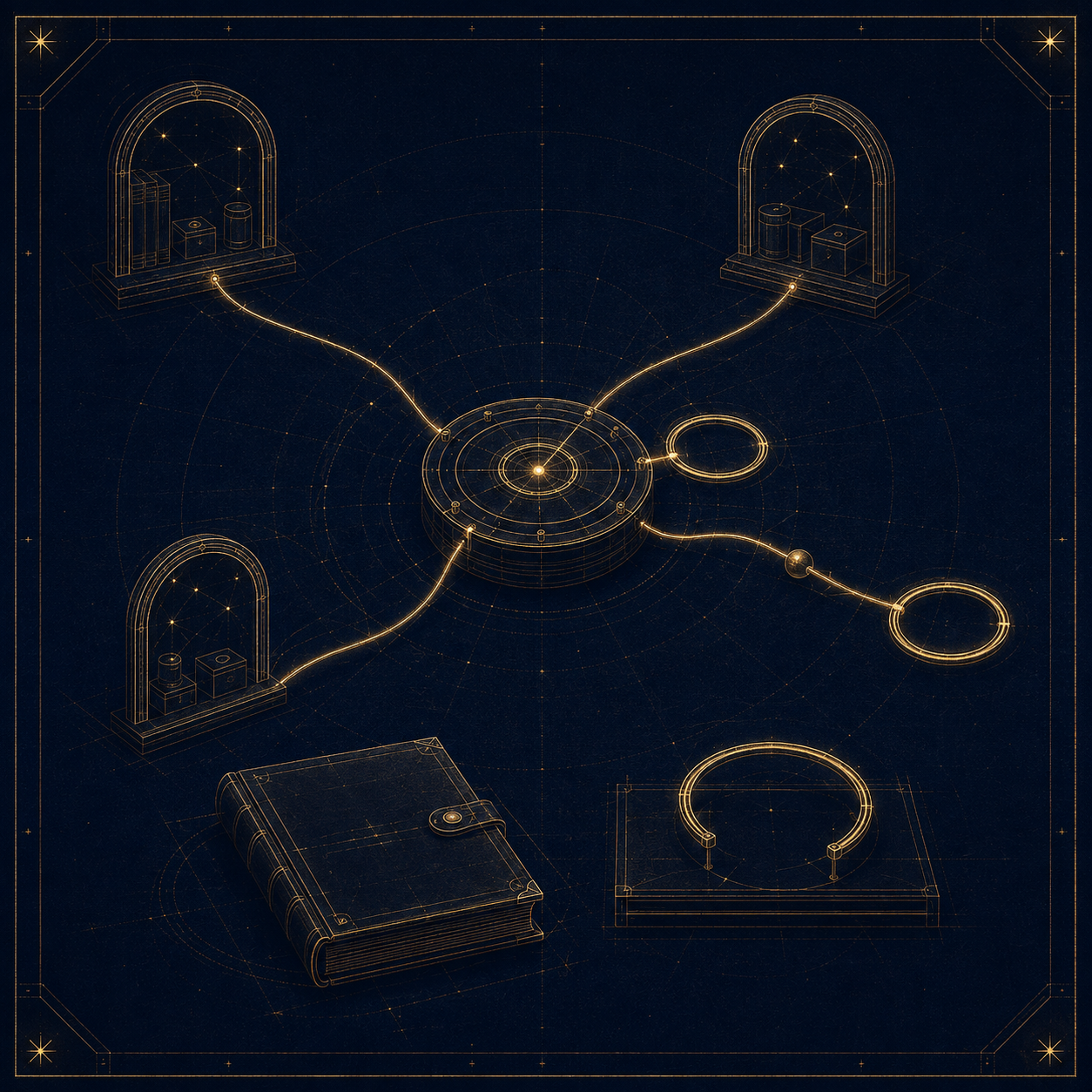
Generated with the built-in image generation tool from the prompt above.
Handoff
WP-0003 is finished. Begin any operational trial with explicitly selected gita repositories and the runbook's acknowledgement/renewal contract. Take the Orwell candidate through its owner's review using COORDINATION-WP-0004. Keep those next steps visible without retroactively calling them evidence from this session.